Who are you becoming?
Lent, the wilderness, and the slow work of spiritual formation.

Hey friends!
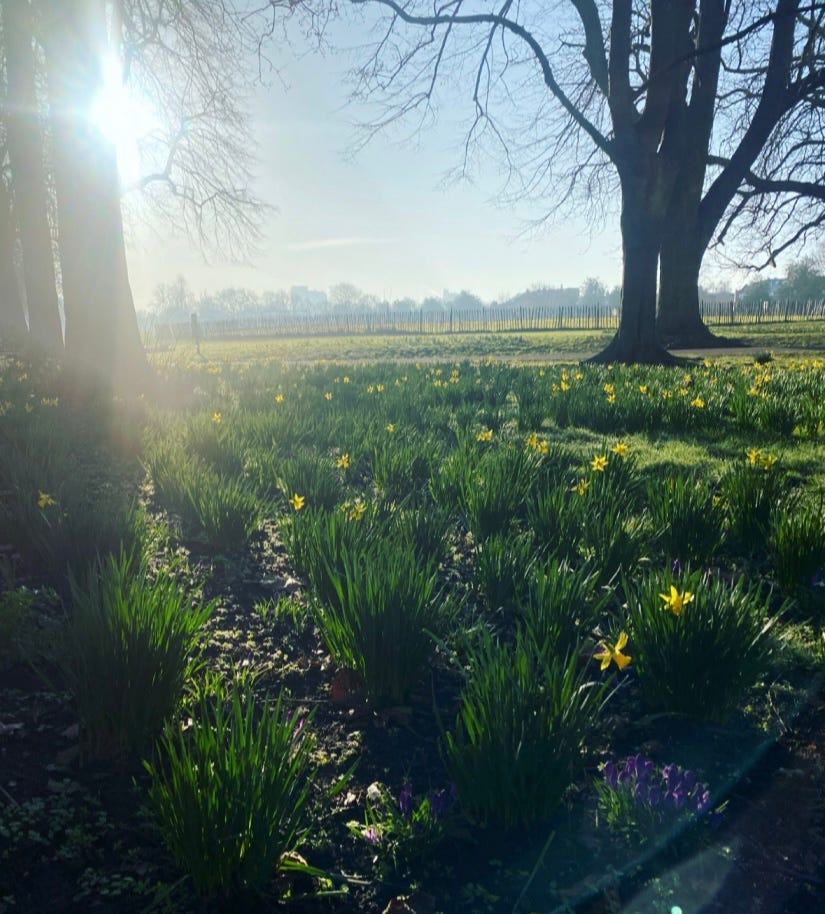
Up until this week, it had rained every single day of 2026 here in London. I’m not sure I realised just how much that quantity of cloud coverage and rain impacts my mood. But this week the sun has finally broken through the moody skies, daffodils have pushed up through the cold ground, and like so many other Londoners, I suddenly feel as though everything will be okay again.
Last week we stepped into the Lenten season, which on the Christian calendar, is the forty days leading up to Easter. Jane Williams writes, “Lent is not primarily about ‘giving things up’, or denying ourselves. It is about finding ourselves.” And I couldn’t agree more. Recently I posted a note on Substack about the death-to-self reality of the Lenten journey, and I find myself reflecting on the deep character formation in my own life, asking myself who is it that I am becoming?
So, this is where we’re headed today. My prayer is that as you read, and perhaps as you journey through Lent this year, you would become curious about the deep work of formation happening within you—about the person you are becoming.
So, let’s dig in together…
But first, a reflection on the quiet work of formation God has been doing in me.
A week ago I sat on a familiar couch at my spiritual director’s house for our monthly session. Sometimes I wonder how she pieces together the rambling threads of my verbal processing each month, but miraculously—and perhaps with a bit of help from the Spirit—she always seems to do so with ease. Her questions, thoughtful and open-ended, tap into something deep within me. I often don’t have clear answers, but I find myself meandering down trails within, noticing how much God is actually at work in me in both seen and unseen ways.
Lately I’ve been reflecting a lot on the peace and love I have been living in as I walk through this recent journey of grief and uncertainty. It’s been quite remarkable, really, as I’m subtly aware of an expansion in my level of trust in God, the rootedness of my identity in him, and the confidence I have in his unchanging character. I suppose I’m realising that the formation I’ve spent my Christian life pursuing actually does work. It really does transform me. As I lean in and do the inner work formation requires, Jesus really does renew my mind and align my heart.
More often than not, we’re in seasons where this is less obvious. Perhaps subtle changes in our reactions or behaviour hint at it. Maybe we notice we’re walking with more patience or moving at a slower pace. Maybe we’re more attentive to God’s presence. Maybe we become aware of some sharp edges softening.
But when you go through something tragic, life-upending, when you’re in the thick of it, you realise where your foundations truly lie. Or as Jon Ortberg says, '“When the bottom falls out of your outer world, you turn to your inner world because that’s all you have left and it’s there you find God.”
And I’ve found that the foundations I built in him are sturdy. I’ve found that I’m able to have peace when surrounded by storms. I’ve found that the deep work in my identity in Christ, the small acts of obedience, the daily choices to turn toward God—all of it has built something solid within me that can withstand the changing winds of circumstance and still hold onto love.
And although I still have a long way to go in my formation—we all do—I feel steadied and encouraged that this work really does transform us. I’m slowly becoming a person more capable of holding both joy and suffering, a person less anxious and more patient. A person who trusts God in all seasons. A person of love.
In a few weeks I’m preaching at church on Exodus 16. This is the section of Scripture where God leads the Israelites into the wilderness for forty years. Throughout this time, he trains them to trust him and to rely on him for all their needs. He starts to deform the ways of Egypt out of them and the slow, steady work of forming them into people who can recognise how deeply loved they are begins—people who believe that God is who he says he is.
The wilderness, it turns out, is often where parts of us must die so something truer can be formed.
As I study and pray over this section of Scripture, I’ve been thinking a lot about the wilderness and the formation that happens there. Two years ago, God very clearly led me into my own wilderness season. Thankfully it didn’t last forty years, but it did stretch out for over a year, much longer than I would have liked.
At the time I was walking in obedience, taking a sabbatical I sensed God invite me into and moving across the Atlantic to a country I felt God calling us back to, and yet I faced significant delays, obstacles, and tragedies at what seemed like every turn. My husband, Dan, and I slept in twelve different beds in a thirteen month stretch, hopping from place to place, no where to really call home. I was stretched between continents and my sabbatical quickly became a wilderness I never expected.
In all the shuffling and shifting, God began to do a deep work within me around identity and calling, uprooting false narratives, healing deep wounds from my past, and reordering my life around an attentiveness to his presence. I had promised to give God six months of sabbatical and he took a year. It was one of the hardest seasons of my life, and yet the work God did in me during that period is something I’m only just beginning to see the fruit of now.
And the difficult fertility journey I’m currently walking in? I know that I wouldn’t be able to stand in the peace and trust and hope I am sitting in without the formation God did within me during that wilderness two years ago. It was a season I wanted to rush through, but one where God took his time. You see, there was work in me that took time. God knew what I needed—what I would need—more than I did. I had no idea then that I would be walking through what I am now.
He’s that good. He’s that loving. He’s that kind.
Who am I becoming?
Well, I’m realising that if I let him—if I practice the spiritual disciplines Jesus taught, seek to live like him, walk in step with the Spirit, stay attentive to God in the ordinary moments of my life, and bring the shadow sides within me into his light—I am slowly becoming a person of love, a person of peace, a non-anxious presence in the world.
The formational work God invites us into is slow and it is lifelong. We will never outgrow our need for spiritual formation in the way of Jesus. I am always a work in progress, but God is so faithful. When I walk with him, when I seek him, he renews my heart and mind so that I can navigate the complexities of this life with a peace that surpasses understanding, a hope not tied to circumstances, and a love rooted in his promises and presence.
It is an invitation into what Jesus calls, life and life in abundance.
And as you faithfully walk this narrow path, every once in a while, you’ll be shockingly aware of just how far you’ve come, of just how much work he’s done within you, and it will fill your well to overflow knowing that God has been at work all along.
The work of God in us is to form lives rooted in love for the sake of others.
There’s a famous phrase from the Desert Fathers and Mothers that positions the goal of the spiritual life as becoming ‘all flame’. ‘All flame’ is described as living in a state of deep, passionate love and communion with God.
This idea of becoming fully alive in God wasn’t just mystical language from the desert, it echoes a much older biblical vision of salvation.
Biblically, salvation was often described using the Greek word theosis, an ancient term meaning “becoming.” In this context, it refers to becoming more like God through living in union with him, sort of like the grafting of human beings back into God’s love.
This transformation, this becoming, is what the Christian tradition has often called spiritual formation. Robert Mulholland defines spiritual formation as, “the process of being formed into the image of Christ for the sake of others.”
To live as loved.
To move toward love.
To become people of love.
For the sake of others.
It’s really easy to think about our formation as work within me for the sake of me, so that I can become whole, so that I can experience the fullness of God’s love, so that I can walk confidently in my gifts and boldly in God’s call on my life. And all of this is certainly a byproduct of formation, but ultimately our formation is for the sake of others, it is so we can become people of love.
If the goal of formation is love, it makes sense that Jesus centers the entire spiritual life around love.
Jesus tells us the greatest commandment of all is to “love the Lord your God with all your heart and love your neighbour as yourself”. It’s not accidental that three loves are woven into one commandment. He doesn’t say the greatest commandments are the following, he says commandment, singular. They all feed into one another with love at the center. We can’t love others well without loving God with our whole selves. And we can’t truly love God while rejecting ourselves as his beloved.
When we become ‘all flame’ and live in complete unity and communion with God, we can’t help but love others well because each person has been created in his image.
Dallas Willard says, “The main thing God gets out of your life is not the achievements you accomplish. It’s the person you become.”
And this is where the conversation hits home.
If I’m honest, I can get so focused on what I’m doing for God that I forget to pay attention to what God is doing in me. And as someone who leads in the formation space within my community, I have to practice what I preach.
Recently I listened to Jon Ortberg talk about formation in the church to a group of church leaders. He said something that’s been echoing within me that I’m bringing to God in this season. He questions, “Is the life I’m inviting others to live the life that I myself am living? Am I sending out my roots like a little seed? … The temptation of ministry is to make the outcomes we pursue more important that the person we become.”
So I ask you the same question I have been asking myself, who are you becoming? Are you moving toward love? Are you allowing God to train you in trust, to form you in the wilderness and the mountain tops and then in all the ordinary moments of your day in between? Are you willing to look at the parts of you that may need to die in order for God to deform the ways of the world out of you and reform you in the beloved child of God you’ve always been, rooted in him.
Because becoming people of love is not simply about adding more goodness to our lives. Often it requires letting something in us die.
There’s a simple question from Henri Nouwen that I’ve been sitting with: “But how can I ever really celebrate Easter without first observing Lent?”
We love resurrection. We don’t love dying. We want the light but not the surrender. The joy, but not the pruning. The Hallelujah, but not the ashes.
But nothing rises that has not first been laid down.
Nouwen prays, “There is so much in me that needs to die…”
False attachments. Impatience. Anger. Envy. The need to be right. The need to be seen.
Lent isn’t about giving up chocolate. It’s about giving up whatever keeps us from Love.
So maybe the prayer this year is simple:
Lord, make this Lent different. Not louder. Not more impressive. Just more honest. Let something in me actually die. So that when Easter comes, it’s not just a celebration, but a resurrection in my heart. Amen.
The Poetry Nook
Recently my cousin Will asked if I had any new poetry to share. When I thought about it, I realised I hadn’t written much poetry lately. Most of my writing recently has been prose—columns, Substack posts, and the bits and pieces that fit around work and everyday life.
At first I assumed it was just a question of time. But the more I reflected, the more I realised it probably has less to do with busyness and more to do with willingness—the willingness to write the poems as they come, worrying less about editing and polishing and more about truth telling.
I wrote this poem around 1am a few days ago, as I was thinking about the theme of becoming.
Who am I Becoming?
Allow me to be steeped in you
saturated by your Spirit
immersed in your truth
soaking
steady
surrendered
until trust becomes my default
until the dividing lines in my heart disappear
until love is my first and last choice
and in between is
all grace
—a patient transformation.
There’s a Book on That
During Lent this year, I’ve been reading Jane Williams’ The Merciful Humility of God. Jane is a theologian and professor—brilliant and deeply wise—and this book has been a real gift to me this season. I once heard her say that before meeting someone, she asks God to give her eyes to see that person as he does. When you speak with her, you sense that it’s true. The book is a beautiful reflection on the humility of God and the invitation Lent gives us to contemplate the whole of Jesus’ life—from birth to ascension—while weaving in the stories of historic Christian figures whose faith journeys reflect God’s mercy and humility.
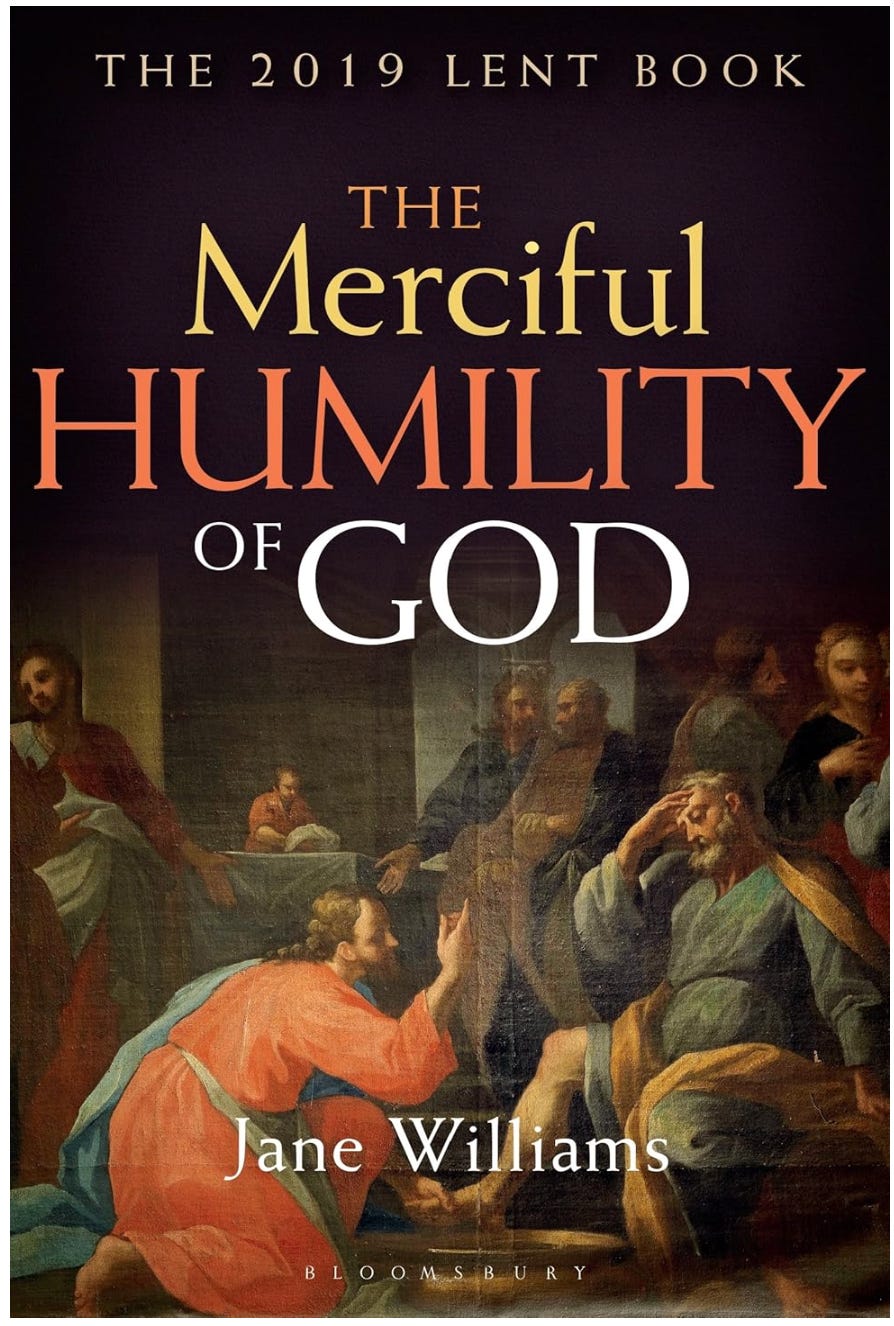
As always, here’s a taster:
“Jesus does not come out of nowhere. Like us, he grows, develops, learns; like us, he becomes who he is; he is not born full grown, but grows into the one we meet in the gospels. The day-to-day encounters, choices, joys and sorrows of growing up help to make him who he is, and so are part of God’s self-gift to us in Jesus. It is not wasteful simply to be; Jesus waits patiently, living his life quietly, unremarked by a wider audience, until the time is right, and then he is ready; everything is there, the fruits of those hidden years, grown to fullness. These Nazareth years are part of God’s humble gift. They give a kind of nobility and purposefulness to what can seem to us like emptiness… This is purposeful living, those hidden years suggest; it is enough to simply relate to God and to each other, and let God do with that what is necessary. Our Lent may start with the confrontation in the wilderness, and the sharp sting of temptation, but it has to continue in daily choices, for 40 days and then for life.”
Just in case you missed these recent posts:
A Hope that Lasts: Hope tethered to outcomes is fragile, but hope anchored in God holds steady even when life unravels.
The Sacredness of an Attentive Gaze: During Advent, we reflect on darkness in the world and within ourselves, waiting with hope for Christ’s light. In this waiting, attentiveness becomes a spiritual discipline, tuning our hearts to God.
The Danger of a Comfortable Gospel: The way of Jesus is narrow and marked by humility, repentance, surrender, and truth, not comfort or compromise. Where are we domesticating God’s Word to fit our own agenda or desires?
Antidote to an Anxious Age: Again and again, Scripture speaks of dwelling in God. But what does it mean to truly dwell in him, and could this practice help shape me into a non-anxious presence in an anxious age?
Quick Reminders
Subscribe
If you’re reading my newsletter for the first time, consider subscribing below! As a subscriber, you will receive this monthly newsletter in your email. You can subscribe by adding your email and clicking “Subscribe” below.
Share
If you like what you’re reading, please consider sharing my posts and substack page with your friends and on your socials. You can share this post by clicking the “Share” button or share the newsletter by clicking the “Share Jamie’s Substack” button below!
Comment
Like or leave a comment below with your thoughts on this post! I would love to start building conversations around these topics with our community here. Click the “Leave a comment” button below to leave a comment, or scroll to the bottom of the post and like or comment there.
Thanks again for reading this month’s newsletter. Cheers to diving into the deep together!
With love,
Jamie