In Good Company
We are called to build community - imperfect, messy, joyful, real community. We are called to be people of love.


Hey friends!
May burst in with sunshine here in London that has felt a lot like summer, but it’s been sneaky these last few years. This spring month seems to butter us up with warm summer days only for June and July to storm in with rain clouds or the notorious all seasons in a single day. But, I’m still holding out hope that the sunshine will roll into summer and the warmth will linger longer.
Although the weather has been wonderful, May has actually been an especially hard month for me. I’ve been navigating a difficult season of grief and disappointment, but in the midst of it, God has actually felt especially close. In some ways, I’ve heard his voice more clearly in this painful season than I have in years. C.S. Lewis once said, "God whispers to us in our pleasures, speaks in our conscience, but shouts in our pain."
But it’s not only God I feel held and loved by, it’s my community — my husband and my family, my community of people here in London (friends and my church family) and those whom I love spread out over locations and time zones all over the world. Although it doesn’t take away the heartbreak, this love fills me up so the cracks don’t feel like chasms. And through his graciousness and unending love, God is slowly filling those cracks with gold, a bit like Kintsugi as a friend recently pointed out so beautifully. I know he will make something beautiful out of the brokenness.
I say all this to emphasize that it couldn’t be a more perfect time to finish off this series on the practices of Jesus with the last one on the list — the practice of community. Imperfect, messy, joyful, real community. We land where it all begins. And truthfully, this one brings it all together because much of our spiritual formation occurs within community. We learn how to be people of love in community. We practice the ways of Jesus in community. We grow into who God created us to be in community.
So, let’s dig in together…
First, a reflection on how my community is helping hold me together in this moment.
Before I begin this part of the post, I want to mention that I do speak of pregnancy loss here.
Before publishing this, I deleted it several times, unsure of whether I was ready to share so vulnerably. But more and more I am realizing how important it is to share stories of God’s closeness in the midst of suffering.
Three and a half months ago I found out I was pregnant. It was the best news my husband and I could hope for and immediately I began to dream of all the things our little one would do in this precious life. My pregnancy symptoms were intense, but I was happy to have them because it meant change was taking place — my body was making room for our baby and beginning to care for it.
Just over four weeks ago, my husband and I went in for my 12 week scan. Anxious to see our little one on the screen we waited patiently for our turn. But the excitement quickly turned to fear as we faced a reality neither of us was ready for. Our baby was much smaller than she should have been. Something was wrong.
We were told we had to come back in two weeks to confirm whether the baby was delayed in development or whether it was in fact what they feared, a missed miscarriage. I thought I might just collapse right there on the floor. My cries were so deep they choked me on the way out — you know that kind of cry you hear from a child who can barely catch their breath. I wanted to disappear entirely.
I wanted to be angry at God. I wanted to yell and stomp my feet and scream at how unfair it all was and how cruel it felt. I didn’t want God’s will if it meant our baby died. I wanted to be angry.
But in that moment, a moment of heartbreak and uncertainty, every part of me felt held and loved by God. All I could feel was this deep, intense love which held me. And even though I felt a depth of sadness that I was tempted to just let swallow me whole, it coexisted with this unending, unchanging, relentless love.
Throughout the next two weeks of waiting, I prayed every day for a miracle but I also simultaneously prepared to let go. I held my stomach and felt all the love I had for this baby, and I prayed and felt all the love God had for me, and it seemed ridiculous that this immeasurable love could coexist with such pain. But somehow it did. In this two week period which felt like a lifetime, I have never felt more loved.
And I wasn’t facing any of it alone.
My husband, Dan, swept in and held me every step of the way. My family created space for me, sharing their heart, sending their love from afar. Friends messaged me daily with prayers and words of encouragement from all over the globe. My church family held me in the heartbreak and prayed with me in the hope for a miracle. My community — near and far — showed up.
And although I felt this slight wall between us because I couldn’t quite face leaving the house and stepping out into the world and I often couldn’t shape the words in my mouth to speak about it all, I felt their love deeply. I felt their prayers powerfully. I could actually feel the love and prayers of many holding me together.
Two weeks later, our second scan confirmed the baby didn’t make it. There was no heartbeat, just a tiny little circle on the screen the size of a pea. And just like that, she was gone. Since my body wasn’t miscarrying the pregnancy, I was scheduled for surgery to clear out my womb the following week.
As we left the scan, I felt the presence of God so strongly. He was with me in this horrific nightmare we were living. He wasn’t distant or removed. And even though he could have intervened and didn’t, he was holding me in the pain, making his love and presence known and real to me every second of every day.
And again, the support and love flooded in. The long hugs and encouraging words, the flowers and plant deliveries, the cards in the post, the visits from friends, the meals sent in or dropped off, the playlists, the Bible verses, and the endless amount of prayers prayed.
I felt it all. And it held me together.
You see, they were all trying their best to love me — to serve and to care for me. It’s not comfortable to be around someone who’s grieving and often we don’t know how to act or what to say, or even worse we say the wrong thing and trigger more pain. But they showed up, imperfectly and lovingly, they were present.
My imperfect, messy, joyful, real community.
And a perfect, loving, compassionate God.
My heart still feels broken and the depth of sadness is real, but I also feel held and loved more than I have in my entire life. And I have hope. Hope that coexists with the suffering, and my community helps me hold onto that hope. They remind me that my faith stands on the truth that our God is a God of redemption and restoration, a God who promises wholeness and eternity, a God who comes close to the brokenhearted and near to the suffering. A God who promises this is not the end of the end of the end. Just one small piece of eternity.
As I made my way to the hospital for my surgery last week, I sat on the upper deck of the bus. By some small miracle, the upstairs was completely empty the whole ride. As the bus meandered its way through the streets of Putney and then Fulham and then onto the hospital, I felt Jesus sitting with me the whole way. His presence so palpable. His love so close. And a soft whisper, “I’ll take it from here.”
I knew in my heart what he meant.
“I’ll hold you through this. And I’ll take your baby girl to Heaven with me today.”
He settles me.
He settles my spirit, my heart, and my mind. He settles my anxiety and my fears. He will settle what was stolen from us far too early. He will settle the debt. He will settle it all.
And so I settle into him. In the midst of the heartbreak. In the midst of the uncertainty. In the midst of it all.
And I settle back into the community who will continue to help hold me together. Knowing that there will be days in the future when I hold them together too.
We’re the most connected we’ve ever been in history but we’re also the loneliest - real, intentional community can bridge the gap and Jesus’ vision for community is the best there is.
In 2022, 49.63% of adults (25.99 million people) in the UK reported feeling lonely stretching from occasional loneliness to constant loneliness. Yes, constant loneliness. And the U.S. is not doing much better. According to a 2024 American Psychiatric Association poll, 30% of U.S. adults reported feeling lonely at least once a week, and 10% said they felt lonely every day. Every day. Younger adults aged 18–34 were especially affected, with 30% experiencing loneliness daily or several times a week.
In a time when we’re more digitally connected than ever before, many of us still feel deeply alone. What we’re missing isn’t more interaction—it’s meaningful, intentional relationships and the kind of community Jesus invites us into is the truest and most life-giving kind there is.
In Jesus’ vision for community the dominant narrative to describe it is love. It comes as no surprise that Jesus prioritized community being that his divine nature is communal — Father, Son, and Holy Spirit. He both taught and modeled a radical vision of community that emphasized love, inclusion, service, and spiritual kinship, and his words and actions consistently reinforced the idea that community is essential to living out God’s will.
When Jesus called his disciples, he intentionally brought together people from very different backgrounds and he included women in key roles within his ministry, something that was unheard of for that time. By doing this, Jesus modeled a community not built on similarity or status, but on a shared purpose: following him and becoming people of love.
In Jesus’ last meeting with his disciples before his crucifixion, he models true community for them by washing their feet. Culturally this carried deep levels of significance. In ancient Israel, people walked on long journeys on dusty roads in sandals so their feet were constantly dirty. Foot washing was a necessary job but it was always reserved for the lowest servant in the household. In this culture, it was the lowest of the low who took on that role. A rabbi would never ever stoop to this level and wash the feet of his followers. This would have been viewed as incredibly undignified.
And yet, Jesus washes their feet, teaching them about the kind of leader he is and the kind of life we’re called to. He tells them, “A new command I give you: Love one another. As I have loved you, so you must love one another.” (John 13:34). Jesus’ language around the community he is calling his disciples to is not vague in any sense of the word, it is a command to love, to serve selflessly. The Greek word here for love is ‘agape’ — it is a selfless, sacrificial, and unconditional love. It is a love that loves without looking for anything in return. It is a type of love that is only possible with God.
Jesus' act of foot washing here encapsulates the heart of the gospel: a call to selfless love and service. He goes on to say, “By this everyone will know that you are my disciples, if you love one another.” The way Jesus calls us to love is what marks us as his followers. This is the type of community he is commanding us to live out — a community built on love for love because of love. You see, it’s always been about love.
And yet, somehow, many of us have lost our way. Sadly, when I think of Christians, the first word that comes to mind hasn't always been "love." In fact, love often seems to fall out of focus completely. We pick and choose who is worthy of our love or we evaluate who has earned it, but the love Jesus is speaking of is unmerited and selfless and it cannot be earned or achieved. And this kind of love is not just a nice sentiment, it is a command straight from the mouth of Jesus. But this kind of love is hard, it’s sacrificial, and it can only be produced through intimacy with God and the work of the Holy Spirit.
Growing into people of love is made possible through Jesus. We have to learn how to walk this out and we learn it in community. And we won’t always get it right, but as Christians, this is who we are becoming as followers of Jesus. We have to believe in the transformative work of Christ in us. As we follow the way of Jesus, we are continually moving toward our calling to become people of love, and we work it out in community together.
So what kind of community are we called to build? We have a tendency to surround ourselves with people just like us, but Jesus’ vision for community isn’t found in sameness; it’s found in diversity rooted in love. It’s a fisherman, a tax collector, and a zealot sitting around a table sharing a meal. It’s Jesus eating with sinners. It’s going out of your way to love and serve people around you without expecting anything in return. It’s showing up in the middle of the grief.
It’s family.
Jesus says, “Whoever does the will of my Father in heaven is my brother and sister and mother” (Matthew 12:50). We are called to build a family — a community grounded in grace, committed to serving others, and rooted in love. A community that loves one another into who we’re becoming—people shaped by love. A community that embraces those the world rejects. That draws near to those suffering and walks with them through the pain. A community that stands alongside the poor, the marginalized, and the downtrodden, speaking life over the lost.
This is the community Jesus modeled for us.
And if we grow this kind of community in our churches and our neighborhoods, opening the doors wide to others and loving people well, we will see our community grow into the diverse and beautiful family Jesus envisions for us.
But it all starts with love.
A love we’ve been so freely given through Jesus, a love which we’re invited to walk in and give away ourselves — imperfect, messy, joyful, real community.
People of love.
The Poetry Nook
Poppy
“It will be okay,”
he said as he held me,
“something new will come from this.”
A new me will emerge perhaps.
One who has more space within her to carry both suffering and joy.
One who can hold the tension between now and not yet.
One who carries hope along the rocky edges of sadness.
Yes, a new me will emerge.
And Poppy?
My sweet Poppy will be in the arms of her Heavenly Father
who will protect and provide for her all her days.
And one day,
one day we’ll meet.
And when I hold her I'll say,
“My darling you shine like the dawn, you’re as beautiful as the moon, and as bright as the sun”.
And she’ll have all the best bits of me and her dad.
And I’ll have an eternity to figure her out.
There’s a Book on That
The Good and Beautiful Community by James Bryan Smith is the third book in a powerful four-part series focused on apprenticing under Jesus to live a life shaped by love. While I highly recommend reading the entire series in order, this particular book offers a rich and compelling vision of what it means to live in a Christ-centered community. Smith writes with both depth and clarity, making complex truths accessible and deeply personal. Each chapter is full of rich content, real life examples, and Biblical truth grounded in Jesus’ teaching, and he even adds soul care exercises at the end of each chapter to help you go deeper.
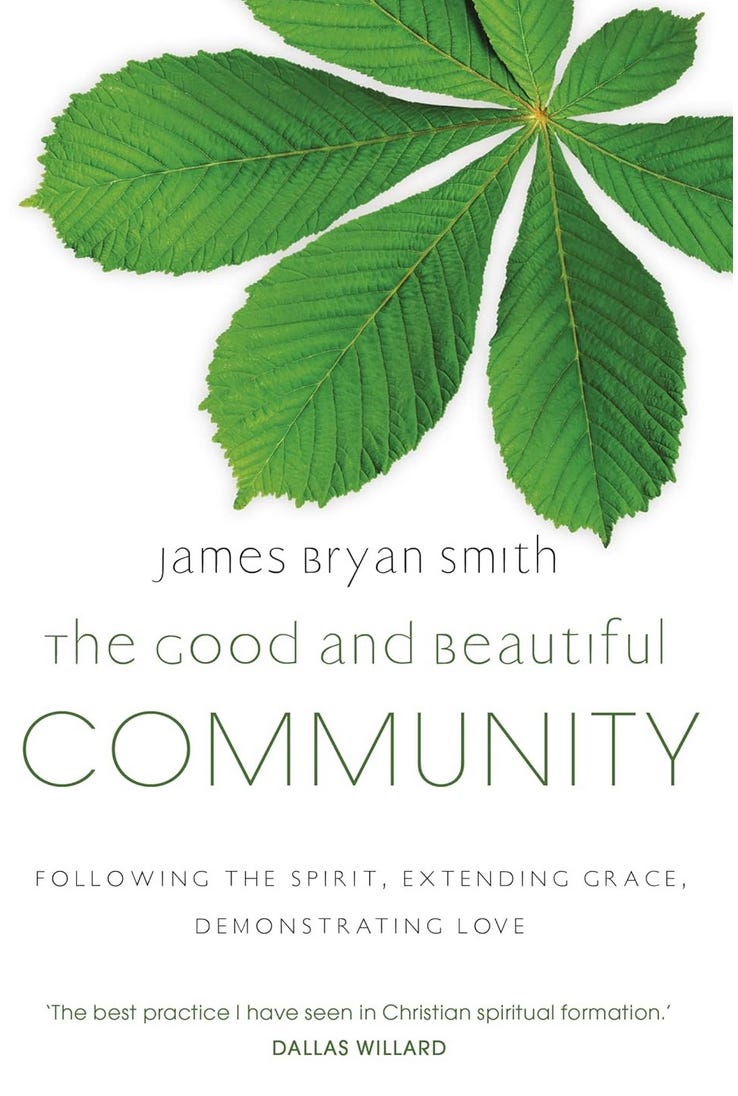
As always, here’s a taster:
“My life is rooted in the eternal and strong kingdom of God; the roots of my life are in the future, safe and secure, which gives me the strength to live unselfishly, to strive for unity in the midst of diversity, to forgive even when it is not easy, to set my standards high, to live generously, to long to be worshipping in the house of the Lord and to be a witness of new life to a dying world. I need to be reminded and I need a community around me to help me remember who and whose I am, and what that means for my daily life.”
Just in case you missed these recent posts:
Reading Scripture: With over 5 billion copies sold, the Bible is consistently the best selling book of all time. What's so special about this ancient text? How can it possibly be relevant to me today?
Humble Service in a Status-Driven World: In a culture that sees power and status as the highest goal, what would it look like to see greatness through the eyes of Jesus? Jesus teaches us that the path to fulfillment is one of humble service.
Being a Witness to a World Seeking Truth: What does it mean to be a witness to the transformative power of Jesus? It's quite simple really, let your life speak.
Revisiting the Sacred Practice of Fasting: The ancient practice of fasting as a spiritual discipline has deep roots in Christianity, stretching back thousands of years. How can revisiting this sacred practice deepen your faith?
Quick Reminders
Subscribe
If you’re reading my newsletter for the first time, consider subscribing below! As a subscriber, you will receive this monthly newsletter in your email. You can subscribe by adding your email and clicking “Subscribe” below.
Share
If you like what you’re reading, please consider sharing my posts and substack page with your friends and on your socials. You can share this post by clicking the “Share” button or share the newsletter by clicking the “Share Jamie’s Substack” button below!
Comment
Like or leave a comment below with your thoughts on this post! I would love to start building conversations around these topics with our community here. Click the “Leave a comment” button below to leave a comment, or scroll to the bottom of the post and like or comment there.
Thanks again for reading this month’s newsletter. Cheers to diving into the deep together!
With love,
Jamie